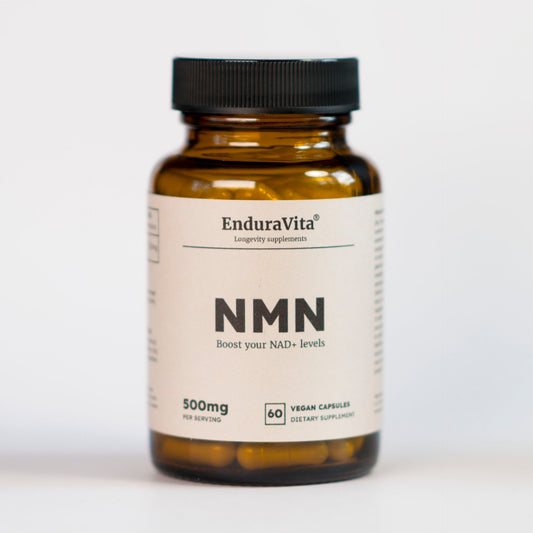
Human study: Uthever® NMN increases serum NAD+/NADH by 38% after 60 days
NAD+ (nicotinamide adenine dinucleotide) is an essential coenzyme involved in hundreds of processes in the human body. It plays a central role in cellular energy production, DNA repair, mitochondrial function, and the activity of sirtuins—proteins often associated with healthy aging.
Research shows that NAD+ levels gradually decline over the course of life. Some studies suggest that available NAD+ levels can drop significantly between the ages of 30 and 60. As a result, in recent years there has been strong scientific interest in nutrients that can support NAD+ production.
One of the most studied NAD+ precursors is β-nicotinamide mononucleotide (NMN).
What is NMN?
NMN is an endogenous molecule that naturally occurs in small amounts in foods such as broccoli, avocado, cucumber, cabbage, and edamame. In the body, NMN serves as a direct precursor to NAD+.
After absorption, NMN can be converted into NAD+ via natural metabolic pathways, making it a widely discussed ingredient in research on healthy aging and longevity.
The Uthever® NMN study
In 2022, a randomized, multicenter, double-blind, placebo-controlled study was published in Frontiers in Aging. In this study, healthy adults aged 40 to 65 received either 300 mg of Uthever® NMN daily or a placebo for 60 days.
One of the aims of the study was to measure changes in serum NAD+/NADH.
Results after 60 days
The researchers reported that participants who used Uthever® NMN showed an average increase of 38% in serum NAD+/NADH after 60 days of supplementation.
In addition, an average increase of 11.3% was already observed on day 30.
These results suggest that daily supplementation with Uthever® NMN may support the availability of NAD-related compounds in the blood.

What does NAD+/NADH mean?
In this study, not only NAD+ was measured, but the combined concentration of NAD+ and NADH in serum.
NAD+ and NADH together form a biological system involved in the energy metabolism of virtually every cell in the body. These molecules play a role in:
- The production of cellular energy (ATP)
- Mitochondrial function
- DNA repair processes
- Oxidative stress response
- The activity of sirtuins
For this reason, NAD-related processes are considered an important research area within the science of healthy aging.
Safety and tolerability
During the study, Uthever® NMN was well tolerated. The researchers reported no serious safety issues during the 60-day study period.
This aligns with other human NMN studies in which doses between 250 mg and 1200 mg per day were generally well tolerated.
Why is this study interesting?
What makes this study noteworthy is that it is a placebo-controlled study in healthy middle-aged adults. This makes the results relevant for people interested in supporting their NAD+ balance as part of a healthy lifestyle.
Although much more research is needed to fully understand all effects of NAD+ support, this study contributes to the growing number of human studies on NMN and the role of NAD+ in healthy aging.
Conclusion
In a placebo-controlled human study with healthy adults, daily supplementation with 300 mg of Uthever® NMN for 60 days showed an average increase of 38% in serum NAD+/NADH.
These results support the hypothesis that NMN may help increase NAD-related compounds in the blood. This makes Uthever® NMN one of the most studied NMN raw materials within current scientific research into NAD+ and healthy aging.
Source
Huang H. et al. (2022). A multicentre, randomised, double-blind, parallel-design, placebo-controlled study to evaluate the efficacy and safety of Uthever® NMN supplementation in middle-aged and older adults. Frontiers in Aging, 3:851698. - https://doi.org/10.3389/fragi.2022.851698